OUR INTERESTS
Research
We explore emerging materials, physical phenomena, and intelligent electronic systems at the intersection of materials science, physics, engineering, and medicine.
Research area 01
Ferroic & Intelligent Materials
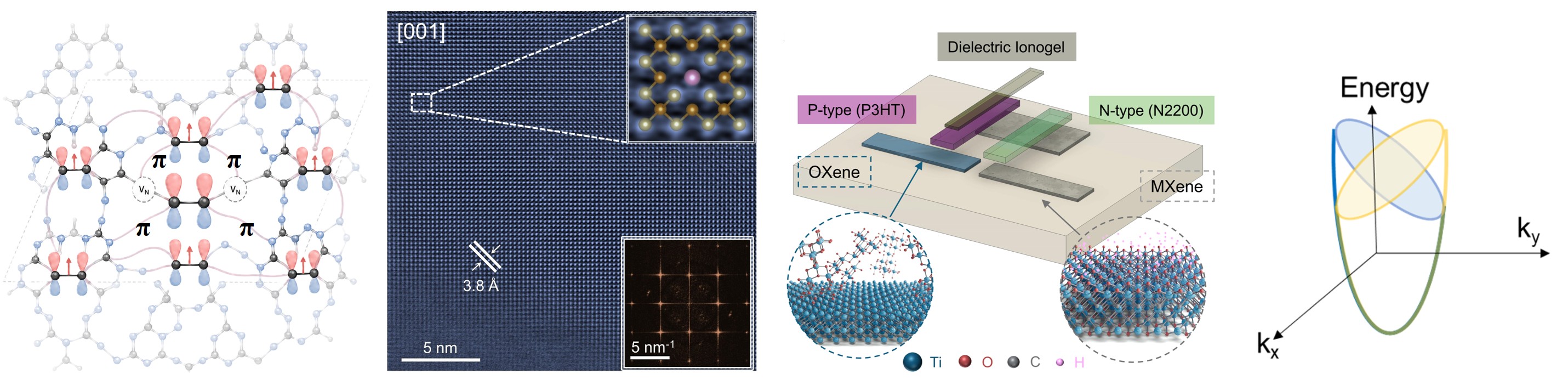
We engineer ferroic and intelligent materials by controlling symmetry, defects, exchange interactions, and interfacial electronic structures. Our research spans metal-free molecular magnets, high-temperature two-dimensional ferromagnetic semiconductors, symmetry-engineered polar materials, and multipolar magnetoelectric systems. By linking atomic-scale structural reconstruction with spin polarization, superexchange, piezoelectricity, and higher-order magnetic order, we seek to create material platforms whose magnetic, electronic, and polar states are robust, tunable, and reconfigurable. These emerging ferroic functionalities provide new opportunities for spintronic devices, adaptive electronics, intelligent sensing, and biointegrated technologies.
Selected publications:
- “Bioresorbable Metal-Free Molecular Magnets Enable Untethered Organ Monitoring” , Nature Materials, 2026.
- “High Curie Temperature in 2D Fe0.98In0.02Te Ferromagnetic Semiconductor via Indium-Induced Superexchange Enhancement” , Advanced Functional Materials, 2026.
- “Exchange-controlled Surface Linear Magnetoelectricity in Rutile-type Altermagnetic Transition Metal Difluorides” , Physics Review B, 2026.
- “Symmetry Engineering in a 2D Transition Metal Enables Reconfigurable P- and N-Type FETs” , Nano Letters, 2025.
Research area 02
Flexible & Biointegrated Electronics
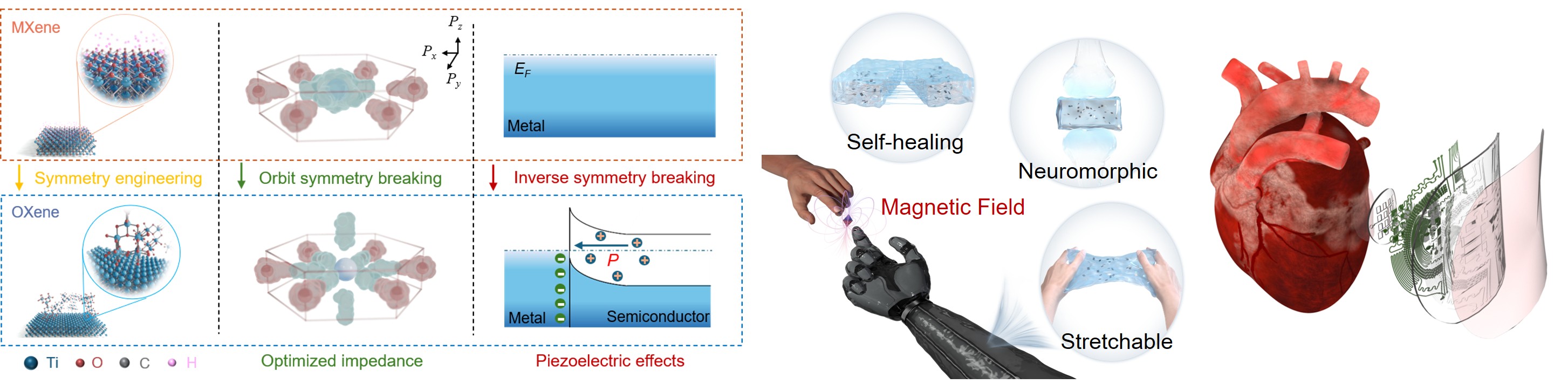
We develop flexible and soft bioelectronic systems by engineering materials, interfaces, and device architectures that seamlessly couple electronics with the human body. Our research leverages symmetry breaking, interfacial charge transport, Schottky-induced polarization, and self-assembled functional domains to create low-impedance, mechanically compliant, and highly responsive electronic interfaces. These material innovations enable high-fidelity physiological sensing, multimodal cardiac monitoring and therapy, wireless and battery-free operation, and adaptive human–machine interactions. By integrating soft mechanics with emerging electronic, magnetic, and neuromorphic functionalities, we aim to develop bioelectronic platforms that are conformal, intelligent, and responsive to complex physiological environments.
Selected publications:
- “Solution-processed electrochromics for synergistic solar and radiative heat management” , Nature Sustainability, 2026.
- “Soft Giant Magnetoimpedance Electronics Enable Contact-free Human-machine Interactions” , Proceedings of the National Academy of Sciences, 2026.
- “Orbit Symmetry Breaking in MXene Implements Enhanced Soft Bioelectronic Implants”, Science Advances, 2024.
- “Skin-inspired, sensory robots for electronic implants”, Nature Communications, 2024.
Research area 03
Advanced Biomedical Solutions
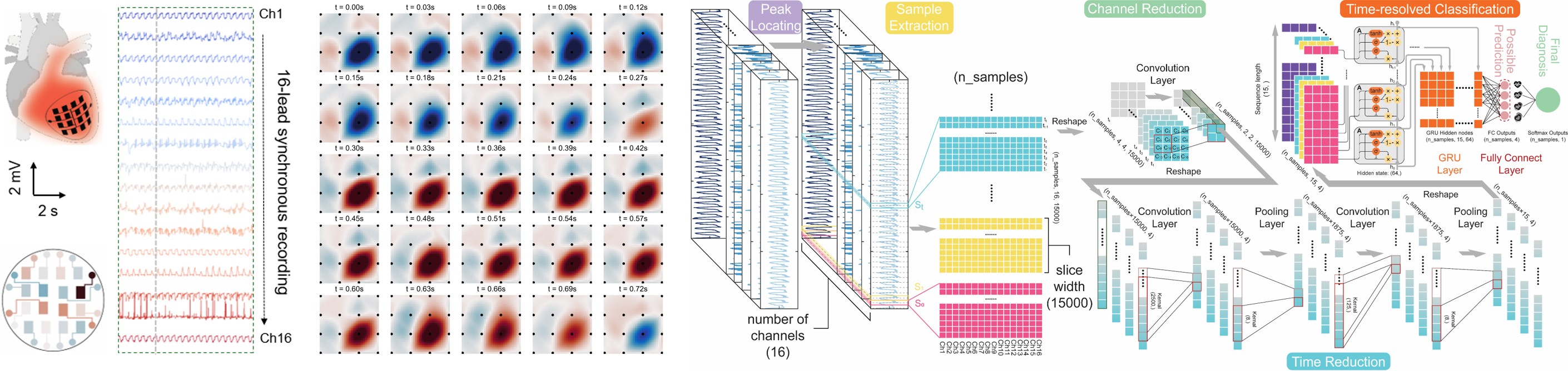
We integrate advanced sensing devices with artificial intelligence to develop application-specific solutions for biomedical monitoring and healthcare. High-fidelity, multichannel physiological signals acquired from wearable and implantable interfaces are coupled with machine-learning and deep-learning frameworks for signal recognition, spatiotemporal mapping, disease-state classification, and predictive analysis. We also explore intelligent interfaces that combine neuromorphic material responses with AI-based decoding to recognize complex interactions and retain temporal information. By connecting device-level innovation with data-driven intelligence, we aim to transform rich physiological signals into actionable information for personalized monitoring, early diagnosis, and adaptive healthcare.
Selected publications:
- “Bioinspired adaptive pupil reflex based on liquid-metal shape-shifters for machine vision”, Science Robotics, 2026.
- “Symmetry Engineering in 2D Bioelectronics Facilitating Augmented Biosensing Interfaces”, Proceedings of the National Academy of Sciences, 2024.
- “AI-boosted and motion-corrected, wireless near-infrared sensing system for continuously monitoring laryngeal muscles”, Proceedings of the National Academy of Sciences, 2024.